
Filmmaker Jafar Panahi on 'It Was Just an Accident'
Clip: 1/22/2026 | 6m 57sVideo has Closed Captions
Filmmaker Jafar Panahi on 'It Was Just an Accident' and challenging the Iranian government
"It Was Just an Accident" from Iranian filmmaker Jafar Panahi is nominated for the Best International Feature Film and Best Original Screenplay Oscars. Jeffrey Brown met with Panahi to talk about his film, his country in distress, and the work of a social filmmaker. It's for our series Art in Action, exploring the intersection of art and democracy as part of our CANVAS coverage.
Problems playing video? | Closed Captioning Feedback
Problems playing video? | Closed Captioning Feedback
Major corporate funding for the PBS News Hour is provided by BDO, BNSF, Consumer Cellular, American Cruise Lines, and Raymond James. Funding for the PBS NewsHour Weekend is provided by...
Support provided by:

Filmmaker Jafar Panahi on 'It Was Just an Accident'
Clip: 1/22/2026 | 6m 57sVideo has Closed Captions
"It Was Just an Accident" from Iranian filmmaker Jafar Panahi is nominated for the Best International Feature Film and Best Original Screenplay Oscars. Jeffrey Brown met with Panahi to talk about his film, his country in distress, and the work of a social filmmaker. It's for our series Art in Action, exploring the intersection of art and democracy as part of our CANVAS coverage.
Problems playing video? | Closed Captioning Feedback
How to Watch PBS News Hour
PBS News Hour is available to stream on pbs.org and the free PBS App, available on iPhone, Apple TV, Android TV, Android smartphones, Amazon Fire TV, Amazon Fire Tablet, Roku, Samsung Smart TV, and Vizio.
Providing Support for PBS.org
Learn Moreabout PBS online sponsorshipGEOFF BENNETT: America's judicial# system is undergoing one of its## most consequential stress tests in# decades, as the president pushes the## limits of executive power and strains the# nation's system of checks and balances.
Over the past year, the courts have# moved to the center of the country's## most significant political fights, while# the Trump administration has increasingly## challenged the authority of judges, whose# rulings have stalled key parts of its agenda.
As we mark a year into President Trump's# second term, we're returning this week## to guests from our On Democracy series,# which explores the laws, institutions,## and norms that have shaped this country and# the different pressures they face today.
We're joined now by Steve Vladeck,## a constitutional law professor# at Georgetown University.
Welcome back to the program.
STEVE VLADECK, Georgetown Universi.. GEOFF BENNETT: I want to start with# immigration enforcement be.. raising the most immediate# constitutional questions.
As you well know, there is this# newly revealed internal ICE memo## that authorizes federal agents to forcibly# enter homes with an administrative warrant,## instead of a warrant from a judge.
And# the whistle-blowers who presented this## memo to Congress says this goes not just# against their training, but also the law.
How do you assess the constitutional# legitimacy of this policy?
STEVE VLADECK: Yes, it's not legitimate.# I mean, the whistle-blower is right.
So the Supreme Court, even as it has poked# holes in the Fourth Amendment over the last 35,## 40 years, the one thing it has kept# coming back to is that an American's## home is their castle.
And so there# are exigent circumstances in which## law enforcement officers are allowed# to enter a home without a warrant.
We just had a case about that a couple of weeks## ago.
There are circumstances where a law# enforcement officer might have probab.. cause to believe that there's a# crime being under way in a home.
But this notion that an ICE officer can simply# sign a piece of paper called an administrative## warrant and use that as a basis for entering# someone's home without any probable cause, without## any exigency, without a federal judge signing# off has no precedent in our jurisprudence and is,## frankly, flatly inconsistent with everything the# Supreme Court has said about the Fourth Amendment.
GEOFF BENNETT: Our team reached out# to DHS and received a statement,## part of which reads this way.
"The officers issuing these administrative# warrants also have found probable cause.## For decades, the Supreme Court# and Congress have recognized the## propriety of administrative warrants# in cases of immigration enforcement."
Is that the case?
STEVE VLADECK: No.
So, administrative warrants, when there# is a b.. crime under way or when there's a basis for# believing that you're definitely going to## find someone who's immediately arrestable and# subject to mandatory detention, that's closer.
But, Geoff, you can't put the cart# before the horse.
You can't say,## we went into the house without a judicially# signed warrant and then found someone who## we could arrest on an immigration# violation.
That's bootstrapping.
The reality is that the government's not supposed# to be able to go door to door without warrants,## barging into American's homes.
I mean, just to go# way back, this was one of the grievances against## King George III that we list specifically in# the Declaration of Independence.
There's a## reason why we have a Fourth Amendment.# There's a reason why it applies even## to folks who are suspected of and may well be# out of status from an immigration perspective.
GEOFF BENNETT: If immigration enforcement in# particular is pushing the limits of executive## power, where does the president's constitutional# authority begin and where does it end?
STEVE VLADECK: So, I mean, at least historically,## we have viewed immigration enforcement inside# the country not as part .. exclusive Article II powers, but as a shared# authority between the president and Congress.
Maybe, Geoff, it's different at the border,# because the president could have an argument## at the border that now I'm engaged in my Article# II self-defense function.
But once we're talking## about law enforcement on a house-by-house# basis in American cities, that's where## it has historically been up to the president# to carry out what Congress has provided for.
Congress hasn't provided for this.
And this# dovetails with this broader push by the Trump## administration, also dating back to last summer,# to treat anyone who's in the country who was never## lawfully admitted, even if they have been here# 30 or 40 years, as if they were stopped at the## border, so that the government can then try to# deny them a bond hearing if they're arrested.
It really is a categorical wholesale rethinking of# immigration law that, Geoff, so far federal courts## have been blocking overwhelmingly judges from# across the geographical and ideological spectrum.
GEOFF BENNETT: When we spoke almost# a year ago about this very topic,## whether the courts could meaningfully# act as a check on executive power,## we didn't really know much because# it was so early into the second term.
But looking back over that year, what has# stood out?
What has surprised you the most?
STEVE VLADECK: I think a couple of# the points that stand out, one is,## the federal courts, I think, have# done a really remarkable job of at## least serving as a speed break on many of this# administration's more aggressive tendencies.
The Alien Enemies Act, for example, was# never successfully deployed because of## the federal courts.
President Trump's# birthright citizenship executive order## still hasn't gotten into effect because of# the courts.
But the courts can't do it alone.
And some of that's because we have had all# these interventions from the U.S.
Supreme## Court that have allowed the administration# to carry out a bunch of these policies while## these cases are going forward.
But even in# the cases where there hasn't been Supreme## Court intervention, the courts are more# of a rearguard action here, Geoff, right?
And you really need multiple institutions# holding each other accountable.
GEOFF BENNETT: Are we in the# midst of a constitutional crisis?
STEVE VLADECK: That question, I think, is --# sort of has different meanings to everybody.
I don't know what the -- where the line# is, where you cross the line and say,## hey, now it's a crisis.
I think we're in# the middle of an institutional crisis,## and we have been for the better# part of a year.
And it's a crisis## caused largely by the fact that we have an# ambitious executive, we have a, I think,## fairly well-functioning judiciary, and we# have a completely sort of indolent Congress.
And the founders set up our constitutional# structure so that the branches would work the## best and our rights would be best protected# when the branches were all pushing against## each other.
With an ambitious executive# and ambitious courts and no Congress,## I think we're seeing the problem, which# is everything comes down to injunctions,## temporary restraining orders, and whether# the executive branch is going to comply.
I don't know that it's a constitutional crisis,# but also I'm not sure that that's the relevant## question.
Our institutions are under pressure in# ways that they really haven't been in American## history.
And although I think the courts have done# a very good job of holding the line to this point,## you know, there's going to come a# point where they need some help.
And whether that's going to be from# Congress perhaps on the far side of## this year's midterm elections or from some# other actors, I think that's going to be## the critical question as we look toward# the next 12 months of this presidency.
GEOFF BENNETT: Steve Vladeck,# always a pleasure to speak with you.
STEVE VLADECK: Likewise, Geoff.
Thank you.
How Trump is challenging America’s judicial system
Video has Closed Captions
Clip: 1/22/2026 | 6m 40s | How Trump is challenging America’s judicial system during his second term (6m 40s)
Jack Smith defends criminal investigations into Trump
Video has Closed Captions
Clip: 1/22/2026 | 4m 29s | Jack Smith defends criminal investigations into Trump during House hearing (4m 29s)
A look at the impact of Trump's immigration crackdown
Video has Closed Captions
Clip: 1/22/2026 | 12m 50s | One year in, a look at the impact of Trump's immigration crackdown (12m 50s)
Trump unveils vision to rebuild Gaza as seaside metropolis
Video has Closed Captions
Clip: 1/22/2026 | 6m 42s | Trump unveils his vision to rebuild Gaza into a seaside metropolis (6m 42s)
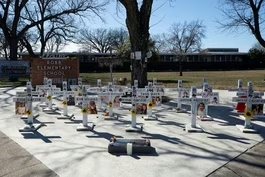
Uvalde officer acquitted of failing to act during shooting
Video has Closed Captions
Clip: 1/22/2026 | 5m 15s | Jury acquits Uvalde officer of failing to act during school shooting (5m 15s)
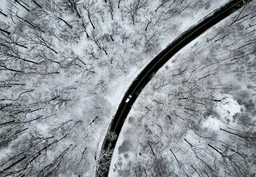
What to expect from the potentially devastating winter storm
Video has Closed Captions
Clip: 1/22/2026 | 4m 37s | What to expect from the potentially devastating winter storm (4m 37s)
Providing Support for PBS.org
Learn Moreabout PBS online sponsorship
- News and Public Affairs

FRONTLINE is investigative journalism that questions, explains and changes our world.

- News and Public Affairs

Amanpour and Company features conversations with leaders and decision makers.











Support for PBS provided by:
Major corporate funding for the PBS News Hour is provided by BDO, BNSF, Consumer Cellular, American Cruise Lines, and Raymond James. Funding for the PBS NewsHour Weekend is provided by...