
Trump proposes $12 billion in aid to farmers hurt by tariffs
Clip: 12/8/2025 | 6m 45sVideo has Closed Captions
Trump proposes $12 billion in aid to farmers after 'exceptionally difficult year'
President Trump announced a $12 billion relief plan for American farmers on Monday. It’s aimed at supporting an industry hit by lower sales, higher expenses and the president’s tariff policy. Patrick Thomas of The Wall Street Journal, joins William Brangham to discuss.
Problems playing video? | Closed Captioning Feedback
Problems playing video? | Closed Captioning Feedback
Major corporate funding for the PBS News Hour is provided by BDO, BNSF, Consumer Cellular, American Cruise Lines, and Raymond James. Funding for the PBS NewsHour Weekend is provided by...
Trump proposes $12 billion in aid to farmers hurt by tariffs
Clip: 12/8/2025 | 6m 45sVideo has Closed Captions
President Trump announced a $12 billion relief plan for American farmers on Monday. It’s aimed at supporting an industry hit by lower sales, higher expenses and the president’s tariff policy. Patrick Thomas of The Wall Street Journal, joins William Brangham to discuss.
Problems playing video? | Closed Captioning Feedback
How to Watch PBS News Hour
PBS News Hour is available to stream on pbs.org and the free PBS App, available on iPhone, Apple TV, Android TV, Android smartphones, Amazon Fire TV, Amazon Fire Tablet, Roku, Samsung Smart TV, and Vizio.
Providing Support for PBS.org
Learn Moreabout PBS online sponsorshipPresident Trump announced a $12 billion relief plan for American farmers today.
It's aimed at supporting an industry hit by lower sales, higher expenses and the president's tariff policy this past year in retaliation for U.S.
tariffs, China initially dialed back its purchase of American soybeans.
That, coupled with persistently low crop prices, have taken a serious toll on farmers bottom lines.
William Brangham has more on the president's plan and how it might play out.
That's right, I'm not.
This aid package includes $11 billion in direct, one time payments to crop farmers through the U.S.
Department of Agriculture.
The remaining billion could be used by farmers whose crops fall outside that USDA program.
The aid comes at a difficult time for smaller family farms, bankruptcies are rising and have been for the last three years.
Today, USDA Secretary Brooke Rollins assured farmers that relief is on the way.
The money will move by February 28th of 2026, but by the end of this month.
So just in the next couple of weeks, every farmer, that is able to apply for it will know exactly what that number looks like.
So as you were going to your lender, as you are working to ensure and understanding what you can plan for next year, you will have that number in hand to help us understand what this means for farmers.
We are joined by Patrick Thomas of the Wall Street Journal.
Patrick, thank you so much for being here.
Before we get to the aid package, I mentioned some of the stresses on farmers, but can you tell us a little bit more about the pressures that they are under right now?
Yeah, and thanks so much for having me on, I appreciate it.
So farmers have had an exceptionally difficult year.
And really, it's been a difficult last couple of years.
So there's a number of different factors.
Number one is just costs.
I mean, when we think of inflation that have hurt the American consumer.
Farmers have also dealt with just normal uptick in costs.
You're talking about utilities.
You're talking about their general living expenses.
But on the farm fertilizer has gone up, an exponential amount, not just because of tariffs.
It's been on the rise for some time.
Seed costs sowed the crop seeds for the corn, soybeans and other things that they plant on their farm.
Seed costs have gone up as well.
You talk about equipment repairs, just general machinery.
A lot of the costs have just been rising.
And then you think about that, coupled with the fact that their revenue is either flat or declining, crop prices for corn and soybeans and and other crops even, too, like wheat and, have been down or have been flat while their costs have been going up.
And that's for a number of reasons.
I mean, we've had a glut of corn and soybeans in this country for, over a year, and that's due to a couple of years of bumper crops.
And farmers are very good at what they do.
So they've they've done a good job of producing a lot of corn, a lot of soybeans, where the biggest corn crop on record, as estimated by the USDA this year.
So that's, kind of a weird twist of fate that doesn't help the farmer when they have too much corn.
And then you have on top of everything that I've just outlined, you have the tariffs that have come into play.
And earlier this year, you saw China stopped buying us soybeans.
China is by far and away the biggest buyer of U.S.
beans.
So if you're a farmer selling your soybeans at eight, $9 a bushel, you definitely lost a lot of money.
You did not break even.
So that is just some of the challenges that farmers have dealt with.
So so there's this $12 billion in aid.
How is that going to roll out?
Will this be direct cash going to the farmers.
What's the timing on this?
Yeah, that is that is the plan is indicated by, Trump administration officials today, saying that they will allow farmers to begin applying over the next couple of weeks.
That if they will be eligible.
And then by February, the USDA secretary said that they will they'll start sending one time cash payments to farmers, as kind of a, band aid fix, if you will, for over this, over this last year of of troubles.
And again, it's been a challenging year.
So band aid implying that this may not be this may be enough to get them through the short term, but long term some of these challenges may still remain.
Yeah.
That's correct.
And you'll hear the administration use a term calling it a bridge.
Quite often what they're alluding to is trying to get the farmer from this year to next year, because farmers have to pay, down their debts.
They have to take out loans and finance for next year's crop.
So they have to they have to take out some debt.
If they're didn't make any money, they're going to take out debt and buy the fertilizer and the crop seeds and start planning for how they're going to do next, how they're going to plan next year.
So they need financing for that.
They have to show the bank that they will have money coming in.
And so what this does is it allows a farmer to go to their bank and say, I'm going to get this aid from the government.
I need to operate for another year and be able to get that loan if they can.
So it doesn't long term fix some of the market issues.
You have this deal with China that is, has some farmers are still skeptical about China holding up its end of the bargain.
If we're going to have long term problems that their buying.
There's just a lot of uncertainty about what the market is for trade and demand long term, for the amount of crops that we produce in this country.
The deal you're mentioning here, this is the deal that Trump and President XI of China struck last fall about China saying, well, we will now start to buy soybeans again from the U.S.
there is some skepticism whether that's going to really pan out.
Yeah.
That's correct.
Just among farmers in general, you know, farmers are always a bit of a skeptical bunch.
But that said, and they would agree with that.
But the, the skepticism I hear from various farmers is really about will China actually buy all that they promised?
Trump and, Scott Bezzant that they've said they would.
So if you recall, there was an agreement between Trump and XI for 12 billion metric tons of soybeans this year.
Originally, the white House said that would be in 20 2025.
And, they're now saying it will be this harvest season.
So there's some uncertainty from farmers about if China will follow through with this.
China has only purchased about 20% of of that 12,000,000,000 million metric tons.
So that that has caused some consternation among farmers.
Will China follow through with this?
It's only been 20% this calendar year so far.
So that's where some of the hesitation is.
All right.
That is Patrick Thomas of the Wall Street Journal.
Thank you so much for sharing your reporting with us.
Absolutely.
Thank you.
Europe rallies around Ukraine after U.S. shifts strategy
Video has Closed Captions
Clip: 12/8/2025 | 11m 3s | European leaders rally around Ukraine after U.S. shifts strategy to the Western Hemisphere (11m 3s)
Indiana Republicans repel calls to redraw congressional maps
Video has Closed Captions
Clip: 12/8/2025 | 5m 9s | Some Indiana Republicans resist White House calls to redraw their congressional maps (5m 9s)
News Wrap: Bidding war brews for Warner Bros. Discovery
Video has Closed Captions
Clip: 12/8/2025 | 6m 40s | News Wrap: Paramount Skydance starts bidding war for Warner Bros. Discovery (6m 40s)
Supreme Court considers Trump's power over federal agencies
Video has Closed Captions
Clip: 12/8/2025 | 5m 52s | Supreme Court hears arguments on Trump's power over independent agencies (5m 52s)
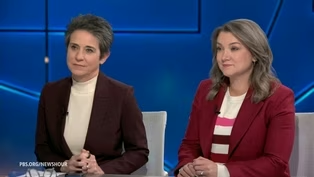
Tamara Keith and Amy Walter on resistance to Trump policies
Video has Closed Captions
Clip: 12/8/2025 | 8m 8s | Tamara Keith and Amy Walter on the pushback against Trump policies (8m 8s)

Why Native Americans are facing high rates of mental decline
Video has Closed Captions
Clip: 12/8/2025 | 8m 56s | Why Native Americans are facing high rates of mental decline (8m 56s)
Providing Support for PBS.org
Learn Moreabout PBS online sponsorship
- News and Public Affairs

FRONTLINE is investigative journalism that questions, explains and changes our world.

- News and Public Affairs

Amanpour and Company features conversations with leaders and decision makers.









Support for PBS provided by:
Major corporate funding for the PBS News Hour is provided by BDO, BNSF, Consumer Cellular, American Cruise Lines, and Raymond James. Funding for the PBS NewsHour Weekend is provided by...