
Voyage of Adventure: Retracing Donelson's Journey
Voyage of Adventure: Retracing Donelson's Journey
7/26/2018 | 57mVideo has Closed Captions
John Guider follows John Donelson’s 1779 river voyage to the founding of Nashville.
In 1779, John Donelson set out on a river journey that would lead to the founding of Nashville. Photographer John Guider followed 240 years later, capturing contemporary images of Tennessee’s waters in a boat of his own making. This is the story of one man’s love of nature. It’s also a story of the Frontier, but not the American Frontier; America was yet to be born.
Problems playing video? | Closed Captioning Feedback
Problems playing video? | Closed Captioning Feedback
Voyage of Adventure: Retracing Donelson's Journey is a local public television program presented by WNPT
In Partnership with The Tennessean. Distributed nationally by American Public Television.
Voyage of Adventure: Retracing Donelson's Journey
Voyage of Adventure: Retracing Donelson's Journey
7/26/2018 | 57mVideo has Closed Captions
In 1779, John Donelson set out on a river journey that would lead to the founding of Nashville. Photographer John Guider followed 240 years later, capturing contemporary images of Tennessee’s waters in a boat of his own making. This is the story of one man’s love of nature. It’s also a story of the Frontier, but not the American Frontier; America was yet to be born.
Problems playing video? | Closed Captioning Feedback
Where to Watch Voyage of Adventure: Retracing Donelson's Journey
Voyage of Adventure: Retracing Donelson's Journey is available to stream on pbs.org and the PBS app.
Providing Support for PBS.org
Learn Moreabout PBS online sponsorship(thunder crackling) - [John Donelson] Wednesday, March 15th, 1780.
Our situation here is truly disagreeable.
The river is very high and the current rapid.
Our boats not constructed for the purpose of stemming a rapid stream.
Our provision exhausted.
The crew almost worn down with hunger and fatigue.
And know not what distance we have to go, or what time it will take us, to our place of destination.
John Donelson.
- [John Guider] He had no experience with the water, there were no charts, he didn't even know the Cumberland when he got to it.
They were attacked by Indians, they had an outbreak of smallpox, one person froze to death, and it really struck me what a great feat that he did.
My name is John Guider and I am retracing John Donelson's journey to the founding of Nashville.
In my little 14 1/2 foot row boat, with a sail, no motor.
I wanted to follow that same path and record what it's like today.
Where we have come from, and where we might be heading.
(thunder clapping) - [Donelson] Journal of a voyage, intended by God's Permission, in the good Boat Adventure, from Fort Patrick Henry to the French Salt Springs on Cumberland River, kept by John Donelson.
December 22, 1779.
- [Announcer] Major funding for Voyage of Adventure is provided by The Anne Potter Wilson Foundation, Martin S. Brown Jr.
And the MSB Cockayne Fund.
Gilbert S. Merritt.
And Dell Nashville, giving today's workforce the technology they need to securely connect, produce and collaborate from anywhere at anytime.
At Dell Nashville, our passion for our customers is equaled only by our passion for the community.
Additional support is provided by the following.
And the Corporation for Public Broadcasting, A private corporation funded by the American people.
(soft music) - [Kathy] In 1779, John Donelson and James Robertson set out on what would be a harrowing adventure.
Robertson would travel by land.
Donelson would lead a flotilla by river.
Their goal was to establish the first large-scale European settlement in what is now Nashville.
Along the way, Donelson would document his voyage in a small journal.
His son, also present on the river journey, is believed to have completed the diary some years later.
At 15 pages, it's one of the oldest and only documents to capture the founding of what would become the capital city of Tennessee.
Nearly 240 years later, photographer and artist John Guider set out to follow Donelson's footsteps.
(adventurous theme music) With his camera and a boat he built by hand, Guider would attempt to capture a contemporary portrait of life on the waters of Tennessee.
The river journey would carry him a thousand miles.
- So many times, in contemporary life, rivers are something just to cross over.
They're an obstacle.
But for me, they are the origins of life.
This is not a recreation, it's a retracing.
A large part of the motivation for this journey is trying to find out who this guy Donelson is.
Here's a man that risked it all, everything, including his family, his wife and his children, to go forward into an unknown place, and why he would do that?
(soft piano music) - There's a boldness, but not necessarily a boldness I would term in a favorable way.
There's an audacity to what they're doing, and a kind of madness to it as well.
Donelson and his associates, what they're doing is to set themselves up as the people who will buy and sell that property, who will profit from that property.
If they can survive, if they can make this trip and stake their claim.
- Donelson, in a way, is doing what many in America have done, and that is creating an identity for himself.
Things are up in the air very simply in 1779, which is perhaps one of the reasons that John Donaldson sort of packs up and leaves.
He's not sure how things are gonna turn out in Virginia.
He's gambling.
The story of America, the story that becomes US history, is a story of moving westward.
It's a story of new lands, it's a story of new places, it's a story of new lives.
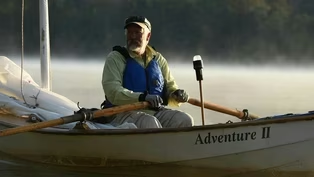
- [Kathy] John Donelson's boat was named the Adventure, John Guider would continue in that spirit by naming his boat the Adventure Two.
- [Guider] The next two months I'll spend on the water.
I'll either be rowing or sailing.
Basically living in my boat.
By being on the river, just a few feet above the waterline, I get to view nature in a very unique way.
I'm on the water looking up at nature.
And I'm looking up in celebration, and in awe, and reverence.
I think some of the photographs can give a reflection of what Donelson saw, and others will give a reflection of what we see today.
And there is a contrast to be drawn.
- [Kathy] For the land we now call Tennessee, the 1700s were a period of extreme transformation.
In the span of a century, a way of life that had sustained itself for 15,000 years would be all but wiped out and replaced by ever expanding European colonialism and eventually a new nation and a new state.
In the years following, the land, the rivers and the people would be altered beyond recognition.
But at the dawn of the 18th century, this frontier west of the Appalachian Mountains, was a cultivated garden, expertly tended by a host of Native American tribes.
(birds chirping) - [Tom Belt] There's documentation that says that the early European settlers that came in these areas, recorded that it was virgin forest, untouched except by the hand of God.
They used terms like pristine.
And what they were actually looking at was a type of agriculture that they couldn't really understand or wrap their minds around.
It was a place that generated life in general for all the tribes involved and was treated as such, in a sacred manner.
And stewarded and maintained in a way that would provide a sustainable life way, a for all the tribes that lived here.
- [Denson] Long before Europeans arrive, there are human communities in these areas that are filling these places with their identities, their cultures, their stories, their religions.
And they certainly don't see themselves as anybody's frontier.
They don't see themselves as going away.
The land's going to be contested.
- [Guider] I started up in Kingsport, Tennessee.
I picked this spot, it was the closest launch point to the original Fort Patrick Henry.
I wanted to feel what Donelson felt when he put in.
The Holston is not a navigable river, so there are not any charts.
So basically, once I launched I was on my own till I made Knoxville.
Ah, this is nice.
My big worry was not in my ability or the elements of the weather but the restrictions that are placed on the contemporary rivers.
The government has taken so much control of the rivers and waterways that even knowing that passage is assured is not guaranteed.
- [Kathy] From the start, Guider's access to the river is uncertain.
Two miles downriver from his launch lies an ammunition plant and the warning signs are clear.
- [Guider] It is very prohibitive.
It just says, "Absolutely no way can you trespass this area."
And my thought is, yes, I'm not gonna be on the land.
I'm gonna be on the water.
I just didn't know how serious they were until I started questioning the locals.
And they said, yes, they're extremely serious.
You can't go past the plant.
It's well-guarded and they will stop you and they will arrest you.
I felt, I'm willing to go to jail for a couple days.
But I knew they would confiscate my boat.
I didn't want to lose my boat.
The journey would've been postponed.
It might've taken a year or two to rebuild a boat, and at my age, things happen.
It was frustrating.
- [Kathy] John Guider conceded and set off a few miles downriver.
His forbearer, John Donelson, didn't have the start he had hoped for either.
(piano music) - [Bill Puryear] Donelson's voyage was nothing but troubles.
The plan was this, Donelson was to bring the women and children and the initial supplies, the capital that they had, and he was to bring his convoy, by the river.
- Donelson set out in the end of 1779 in December, just before Christmas.
And The worst winter that's been recorded, unleashed its wrath at that point the Holston, it froze, they had to stop.
- [Donelson] December 22nd.
Took our Departure from the Fort and fell down the river to the mouth of Reedy Creek, where we were stopped by the most excessive hard frost.
And after much delay and many difficulties we arrived at the Mouth of Cloud's Creek, where we lay by until Sunday, February 27th, 1780.
- [Clement] It was cluster.
They were frozen up for two months.
- [Guider] Living in that cold for two months, what sort of straits is this guy in that he wants to continue to risk it all, even though they've got to be running short of food and the family's got to be miserable and disagreeable and yet he continues to hold them in place.
It seems unrealistic for them to continue.
And yet they do it.
- [Kathy] Throughout the 1700s, pressure is mounting for British colonists to move west beyond the Appalachian Mountains.
But the pressure is really coming from all sides.
The Spanish and the French empires are also vying for territory east of the Mississippi River.
Native American tribes are in the middle, defiantly hanging on to the world they have known for millennia.
For the Cherokee in this region, it is a violent and dislocating time.
- [Belt] The tribes were aware of what colonials had done and were doing, way before it reached the lands of the tribes themselves.
For a long time I suspect that the tribes were trying to figure out exactly what kind of people these were.
- [Albert Bender] Between 1600 and 1700, it's estimated that 95% of the native population east of the Mississippi, reached its demise due to infectious diseases.
From 1700 to 1800, you had an acceleration of military conflict, because what was in question is, who would control the vast, vast areas of land east of the Mississippi.
- [Kathy] Amidst a near century of conflict, the French and Indian War is a decisive moment.
Native American tribes choose sides.
Some sided with the French, other tribes, like the Cherokee fight along side the British.
For the tribes on either side, they are fighting to maintain their autonomy and culture.
Ultimately, everyone involved is fighting for one thing, land.
- [Clements] The French and Indian War was brought to conclusion in 1763, and the deal was, because the native tribes had helped England, that there would be no expansion beyond the Appalachian mountains.
- [Kathy] King George's Proclamation line of 1763 creates a dividing line that is real for the wealthy British landowners in the East.
The Cherokee hope the line is real, but treaties are being broken almost as soon as they are created.
For the fracturing population of British families already on the frontier, the Proclamation Line of 1763 is imaginary from the day it is signed.
- [Clements] They were just waiting, like there is all this wealth, and all we have to do is get over there, we've got this proclamation of 1763, that's saying we can't, but we're gonna do it anyway.
- [Guider] Tuesday, September 6th.
ALovely mist lay over the river as the overhead sky turned its morning blue.
This is why I came.
The beauty and calm is unmatched.
Vincent Van Gogh stated, "If one really loves nature, one can find beauty anywhere."
I learned early on that it takes about two weeks for me to adapt, to physically feel one with the river, one with my boat, to be comfortable sleeping on its floor.
This is so beautiful.
Usually I'm up with the sun.
The birds start chirping and nature comes alive.
And, I'm never in a hurry.
I'm living life at two miles an hour.
The mornings are for photography.
And I photograph without restraint as my boat floats the quiet mist-softened, sun-washed waterway.
The light is constantly changing.
There are the golden hours of the morning, and the golden hours of the night, where the light is not only warm, but the sun is lower and creates these beautiful shadows and tapestries on the water.
The light gleams through the leaves, and picks up the highlights of the birds.
And even during the day, when the light presents itself, when the clouds and the landscape presents itself, I'm there, I'm ready.
And there is a nice moon and look at the light on the clouds, holy mackerel.
This is paradise.
- [Kathy] Donelson's idea of paradise is the Cumberland Settlements, but there would be hell to pay to create them.
- [Clements] Both James Robertson and John Donelson were people who had leadership qualities, Robertson was born in 1742, and he got married in the mid 1760s and very soon was coming across the mountains in defiance of the royal proclamation to settle in what was called Watauga.
And he had heard from various people who were the long hunters.
They were saying, look, Watauga's OK, but my gosh, that's Boardwalk and Park Place over there.
- [Puryear] The longhunters told of a promised land overrunning with game, filled with springs of clear, cool water that ran all year.
- [Clements] And what Robertson heard from the long hunters, Donelson saw for himself in Kentucky, and he wrote a letter that said, my gosh, I've seen paradise, so his eyes got real big.
This was wealth, this was the way to get financial security, and he could see how to do it.
- [Guider] Thursday, September 8th.
I woke to the loud screeching of a Cooper's hawk.
I was close to its nest and it was eager to see me move on.
The best part of sleeping in the boat is that I can be underway in just a few minutes.
Just roll up the sleeping bag and hoist the anchor.
One of the other things I like about photographing on the river is that, in my rowboat without a motor, I'm kind of in a stealth mode.
I'm very quiet, I'm very unobtrusive, and so it gives me an opportunity to observe nature, and the wildlife, and to see the interactions of the animals, and see how they react to one another, and to their environment.
It gives me that opportunity to witness life in a way that few other people get to see it, and it brings me closer to nature, and it's revelatory.
And it's exciting.
The rivers themselves are these incredibly powerful giants.
They flow with an energy that, no matter where I am, they can take me to the ocean.
You know, one of the biggest contrasts between John Donelson's journey, and my journey, is that once they made that commitment, there was really no turning back.
- [Kathy] If James Robertson and John Donelson needed any motivation to set out on an adventure, they found it in Richard Henderson.
In 1775, Henderson single handedly negotiated the purchase of 20 million acres of land from a group of Cherokee leaders.
It would be the largest private transaction of land in US history and its legitimacy would be questioned.
- [Bender] According to Cherokee history, the chiefs who negotiated that transaction, they later completely repudiated the Treaty of Sycamore Shoals saying one, their concept was that they were granting them limited grazing rights on certain parts of the land of what is now Kentucky.
Cherokee leadership said that they also thought that the trade goods were an indemnification for damages done to Cherokee towns.
- [Denson] The land we're talking about is just mammoth.
It's just millions of acres between the Kentucky River and the Cumberland River that is, supposedly, sold, you know, ceded to this guy who has no right to this, under anybody's law, under Cherokee law or British law.
- [Kathy] Before the Treaty of Sycamore Shoals is complete, a prophetic statement is made by the Cherokee Chief of Big Island Town, Dragging Canoe.
- [Bender] Dragging Canoe was adamantly and vehemently opposed to the sale.
And he said, "Anything that you do on these lands you will find it will be dark and bloody ground," and with that, he walked away from the treaty negotiations, and the transaction went through for whatever it was.
- [Denson] Once that purchase is made, in this very, very disturbed time in the beginning of the American Revolution, it's just open season on Cherokee land.
- [Kathy] Richard Henderson tasks James Robertson and John Donelson with running the survey lines and establishing his claim to the lands of the Cumberland River.
- [Donelson] Thursday, March 2nd.
Rain about half the day, passed the mouth of French Broad River, Mr.
Henry's boat being driven on the point of an island by the force of the current was sunk, the crew's lives much endangered, the whole cargo much damaged.
The same afternoon Reuben Harrison went out a hunting and did not return that night, though many guns were fired to fetch him in.
- [Guider] Sunday, September 11th.
The rain had passed quickly and the sun was out in full.
The river was lovely with the verdant hills rising high on either side, forming a perfect V pointing me toward my goal.
Soon the river widened as the French Broad came into view.
The world seemed to come alive.
I borrowed a cell phone to try to fetch Mark in.
On my adventures, I love that I get to see friends like Mark Fly, who have supported me on so many journeys.
One aspect of my travels, is that not only am I vulnerable to the environment and the weather, I'm very vulnerable to the people who live around the water, and in some respect fairly defenseless.
And what I've found is, that with my vulnerability, comes a humanity.
People do not see me as a threat, they see me as a curiosity, and they want to learn more, and find out what it is I'm doing.
It's not my ability to survive, it's the people who I meet, that reach out and help me go forward.
They make me realize that it's a good world that I live in.
And so, a lot of the fears that I have, when you listen to the news, and listen to the chaos, it's dispersed.
- [Kathy] The chaos of the Revolutionary War cracks open opportunities for Henderson, Robertson and Donelson.
With the newly inked Declaration of Independence, all the rules go out the window.
- [Honor Sachs] People ascribe a level of meaning to 1776 that didn't actually exist.
The idea that America had a sense of destiny in this region is one of the greatest myths of this era.
America does not exist, nobody knew who was gonna win the war, there was no government.
There's this idea that the Declaration of Independence founded our nation, which is absolutely false.
The Declaration of Independence founded nothing.
There is nothing in there about a plan for government, about the way in which a nation was gonna organize itself.
The Declaration of Independence did one thing, and it did it well, and that was to end American relationship to an empire.
It was a destructive document, it destroyed an empire.
It did not found a nation, that was years off, and potentially at the end of a war that might not be won.
- [Kathy] As John Guider nears the confluence of the Clinch River, another historic event is on his mind, this one more recent.
On December 22nd, 2008 a TVA coal ash impoundment failed, sending 5.4 million cubic yards of coal ash into the nearby waterways and wetland habitats.
10 years and $1.4 billion later, the full breadth of impact remains to be seen.
- [Guider] For me to come that day, with the bright sunlight and the blue skies, it just looks so natural and so peaceful.
But at the same time, I know that there are people who are still, after 10 years, refusing to drink the water.
There's signs that say do not fish.
There's a lot of concern.
And I see people water skiing, and I see kids jumping in the water swimming.
And they think that, because it's water and it's a great big lake, that it's perfectly OK.
And I'm wondering if they really knew what was in the water, would they so willingly let their children swim so close.
No matter where you are, you can't be assured of the river quality.
The boat keeps me dry and keeps me safe but I just don't know how much involvement I want with the river water.
I enjoy the water but I'm respectful of the harm it can do as well.
- [Donelson] Monday, March 6th.
Got under way before sunrise.
The morning proving very foggy, many of the fleet were much bogged.
Camped on the north shore, where Capt.
Hutchings' negro man died, being much frosted in his feet & legs.
Tuesday, March 7th.
Got under way very early, the river being wide occasioned a high sea, insomuch, that some of the smaller craft.
were in danger.
We lay by that afternoon and camped that night.
The wife of Ephraim Peyton was here delivered of a child.
- Part of the reason why whole families went was because whole families were required to establish settlements.
The kind of which would be deemed permanent and legitimate.
Women were actually crucial to the sustaining of life in a household.
So In many ways, that sort of combined labor of settlement, of establishing a household required the work of lots of people.
The interests of investors and agents like Donelson, like Boone, like Henderson was to amass large areas of land and then profit from it, to bring then settlers into it, to profit, to sell off small tracts of land.
Their interest was entrepreneurial, it was capitalist, it was motivated by individual opportunity.
- What Robertson and Donaldson were trying to accomplish, and what Richard Henderson was hoping they'd accomplish, was to bring a lot of people into this area.
The Donelson group, there were probably, at most, 40 vessels.
And sometimes they were big, large flat boats.
And sometimes they were small.
There were slaves, there were children, there were old people, there were strength in numbers.
You never want to go into the wilderness by yourself.
- [Davis] American Negro slavery is a reality of the moment.
They are with Donaldson.
He picks his people up, he moves with them.
You needed hands, you needed laborers and that's what slaves were.
You've got rather crude craft.
You've got only human propulsion and the tides for movement.
You're rowing the boat or the barges and those are heavily laden.
You're fighting the currents, you're fighting the elements.
And as I think of circumstances, such as the Donaldson voyage, it just reminds me of how hardy those folk must've been.
- [Kathy] In the colonies, on the river, the ideals of the American War for Independence are not lost on enslaved people.
- Throughout the colonies, blacks are making a very careful calculation about, where do my best hopes lie?
And so, blacks line up on both sides of the line.
They are fighting with those who like to be called Patriots.
They're fighting on the side of those who are gonna come to be called Loyalists, seeking their way out of slavery.
Making this say, a moment of change for themselves.
- [Sachs] Slavery is absolutely incompatible with the ideals of the American Revolution.
So the idea that enslaved people might find a home, might become part of this new nation, was a motivation, a power motivation for many enslaved people to force that question, and to engage in that dialog, to prove themselves worthy of a place in this new nation.
- [Davis] The Donaldson journey as we understand it, should reinforce a sense that the United States has been a place that has been made by cooperative effort.
It's been a place that's been made where blacks have been in the forefront of laying the foundation, of building the buildings and making things go.
Too often, the thing American Negro slavery is discussed as if it's tangential to US history.
And it's not tangential, it's essential, it's integral, it's part of the core of what made the United States what it is.
- [Guider] I started these journeys because I didn't want fear to be a major deciding factor in my life, and this is who I am.
I feel I'm doing something that's unique enough that it's not an everyday occurrence.
When I was in the commercial arts we regurgitated that which was current.
And I lost that sense of individuality.
And here, I feel I'm an individual and that's what an artist has to be.
These images can go forward 100 years, 200 years.
And hopefully somebody may discover them and see what the world looks like in comparison and say hey, we did good or hey, we need to do a little better or hey, we really screwed it up.
(boat horn sounding) - [Kathy] In a voyage plagued by troubles, Donelson's suffering is just beginning.
As his boat proceeds downstream, the next objective will be to float into a war zone.
- [Donelson] Wednesday, March 8th.
Castoff at 10:00 and proceed down to an Indian village, We observed a number of Indians on the other side embarking in their canoes, armed and painted red & black.
And here we must regret the unfortunate death of young Mr.
Payne on board Capt.
Blackemores boat, who was mortally wounded by reason of the boat running too near the northern shore opposite the town where some of the enemy lay concealed, and the more tragical misfortune of poor Stuart, his family and friends to the number of 28 persons.
- [Kathy] As Donelson entered the Tennessee River Valley, his flotilla would encounter a formidable military opponent.
Chief Dragging Canoe had established a network of towns intent on stopping colonial expansion and holding their land.
- [Denson] Donelson knows what he's getting into.
They are at war with the people whose country they're floating through.
- [Bender] Dragging Canoe's military strategy, was called a Defense in Depth.
The further the invading force got down the Tennessee River, the more and more hostile Cherokee war companies that they would have to encounter.
- [Sachs] One of the things that I want people to think about when they read a document like the Donelson Journal, is how dangerous and how actively at war this space was.
There's a myth and a presumption that war was sort of a side narrative.
That there was this revolution and then there was these explorers and these were two separate stories.
But in fact, that was part of the war itself, that these people were engaging in acts of war and that they were living in context of incredible violence.
- [Bender] The Donelson party, to my historical research, was the only riverboat party of whites to get through the Tennessee River after the start of the Cherokee war.
In other words, Dragging Canoe blockaded the river and blockaded it so effectively that no white settler expedition could get through.
And that river was blockaded for 18 years.
- [Kathy] Among the causalities would be the newly born child of Mrs.
Peyton.
During a firefight, their boat had become caught on the shallow river bottom.
In the haste to lighten the craft and escape, it is believed the infant was thrown overboard.
- [Guider] I love these journeys but I realized that two months is enough.
I like the fact that if something went terribly wrong, I get to the river bank and walk to the nearest highway, stick out my thumb and in an hour or two, I'd be safe.
Donelson didn't have that.
Like the mussels that lay so famously in the Tennessee waters, I myself was encapsulated in the shell of my own making, the Adventure II.
During the day the lid would open to reveal the spectacle of the outside world.
Then at night the cover of my Bimini top would confine me to a universe of only a few square meters.
The confinement would make me both safe and vulnerable to forces outside my intimate domain.
The isolation and the ignorance of what might be lurking could either be calming or frightening, as one's imagination has a way of running wild.
The calming of the mind brought on by exhaustion is one of the true gifts of hard work.
The beauty I see when I lift the camera, there's a poetry.
I try to replicate that, I want people to see nature as it is and how life giving it is and how it needs to be celebrated and protected and so that is my mission to make nature the prime source of beauty in the world.
What you see is a river that's totally vacant of traffic.
It's the middle of the work week.
Very few pleasure boats are out here and there's so few commercial vessels that maybe if you're lucky you see one every two hours.
Other than that, you have this expanse to yourself.
At the end of the day you look for a little cove, and get off the main channel so a boat won't run you over or swamp you out.
Put up your little bimini, and go to sleep.
And the next morning comes, and you start it again.
- [Kathy] Now, the River itself posed a threat to Donelson's journey.
Even the earliest maps of the region document an epic stretch of rapids on the Tennessee River called Muscle Shoals.
The Shoals was one reason Donelson chose the seasonally high waters of winter for his journey, but truthfully he hoped to skip it all together.
James Robertson was to rendezvous with the Donelson party and provide an alternative land route to the Cumberland Settlements.
He never showed.
- [Donelson] Sunday, March 12th.
Came in sight of the Muscle Shoals.
Halted on the northern shore at the appearance of the shoals in order to search for the signs Capt.
James Robertson was to make for us at that place.
But to our great mortification, we can find none.
- [Kathy] With war at their back, the Donelson flotilla had no choice but to brace themselves and face the unrelenting fury of the river.
- [Donelson] When we approached them they had a dreadful appearance to those who had never seen them before.
The water being high made a terrible roaring, which could be heard at some distance, among the drift-wood heaped frightfully upon the points of the island.
The current running in every possible direction.
Here we did not know how soon we should be dashed to pieces and all our troubles ended at once.
Our boats frequently dragged on the bottom.
And appeared constantly in danger of striking.
They warped as much as in a rough sea.
But by the hand of Providence we are now preserved from this danger also.
- [Kathy] Muscle Shoals would not be tamed until 150 years later.
The creation of Wilson Dam would submerge the Shoals beneath the deepened Tennessee River and lead to a complete transformation of the Tennessee River Valley.
- [Donald Davidson] "Down the valley of the Tennessee two rivers flow, two rivers blended indistinguishably where for centuries there was only one.
One of these, uppermost and immensely obvious, is the new Tennessee, a man-made river, the product of engineering operations of such calculated daring that the imagination is daunted to find precedent for them.
Designed and finished in a little over a decade, it is less a river than a chain of lakes, formed by the impounding of river waters behind great dams that stand athwart the valley in Egyptian impassivity.
This shining modern thing, so new that it's concrete structures have not had time to weather is the river of the TVA.
Donald Davidson, 1946.
- [Guider] I made the Chickamauga Lock and Dam around 5:00 in the evening.
I called the lockmaster and he said a boat was coming up and as soon as it cleared, he would let me down.
So within 15 minutes I was in the lock ready to descend.
Usually, on my journeys, I'm heading downstream, so the gates open, and, the top of the gate may be 10, 15 feet above the water line, not that high, so it just looks like you're going into this big corral.
Then you hook up to this floating mooring buoy, and as the water gets let out, you gently lower and lower, and the cavern of the lock gets bigger and bigger.
And behind you, the doors just grow massive, and there's water kind of rushing through, and there's little leaks and things going on, and you're just in awe of the structure, and pretty soon it bares itself to you.
It can be as high as 80, 100 feet, and you're in this giant, giant cavern.
Tennessee wouldn't be Tennessee without the locks and the dams and the power plants that go with them.
There's an energy in design, there's an energy in building.
There's an energy of saying, look what I've made, and the society and civilization gets behind that, but what happens three or four generations down the road when they say, what are we doing here?
There is a problem that's lying ahead, and we've created it, but it's the future generations that have to own it.
(acoustic guitar) I had slept close to a tall cypress and its toes reached out to the boat looking like ancient melted candlesticks.
Wild flowers grew from the soil around its base.
I made lots of photographs knowing how much joy I was going to derive from visiting the images and reliving the moment for years to come.
The experience was also highlighted by the knowledge that almost 240 years prior, the Donelson party camped nearby.
Their thoughts most likely centered on survival and the great rewards of building their fortunes on such fertile, virgin lands.
- [Kathy] Seeing the river from Donelson's perspective is no longer possible, but equally transformed is the land that would support the Cumberland Settlements.
- [Dwayne Estes] There's a famous myth among most people who grew up in Tennessee, what we call the myth of the squirrel.
That at the time the first Europeans got here, that there was this dark, foreboding landscape with trees stretching from the Atlantic coast to the Mississippi River.
Forests so extensive and so dense that a squirrel could travel through the canopy all that way without touching the ground.
We know now that it's not an accurate picture.
When James Robertson would have come across, they would have encountered one of the largest grasslands that we have in the mid-South.
Here in Tennessee, there were probably somewhere between seven and eight million acres of grasslands at the time of European settlement.
- [Kathy] Native grasslands, savannas and deep soil prairies allowed the large populations of game, described by the longhunters, to flourish.
Dense with buffalo, deer, elk, quail and innumerable other species.
They meant one thing to the Native American tribes, and another to the approaching settlers.
- [Estes] The grasslands, I think to those settlers who were beginning to expand westward were really important.
In ways that probably has never really been fully written about.
Because the forests weren't there, it means that it was easier to settle, and therefore a lot of these grasslands were kind of easier to destroy.
And, that's one reason why today, for some types we've got, and it's no exaggeration, 99.999, you can stretch that on out, percent loss for things like these deeper soil prairies.
- [Kathy] The removal of natural wildfires and flooding from the ecosystem, alongside development for agriculture and commerce, have meant that native grasslands have all but disappeared across Tennessee.
- [Estes] The state is utterly and completely transformed in many ways from what it would've been originally.
The grasslands are gone, the open savannas and open grassy woodlands have largely closed in and become thick forests.
Of the original grasslands, you're looking at less than half of a percent that still remains on the landscape.
That's what we got to work with.
So if we wanna tell that story of the history and of conservation, we've got to start with those remnants.
- [Guider] Wednesday, October 5th.
My experience on the river has always been going downstream to access the Mississippi from Nashville.
Both times in my little boats the Ohio's current had always run fast, up to four miles an hour.
How was I going to be able to row against that force for a sustainable amount of time?
In my haste to leave home I had forgotten the charts for the Ohio.
Now I was just like Donelson.
- [Kathy] Donelson had not intended to see the river beyond Muscle Shoals, he had no charts, no idea how long it would take to reach the Ohio or the Cumberland from their place on the Tennessee.
With no other option, they continued on.
Donelson was well aware of one thing.
Once they turned onto the Ohio, the journey to the Cumberland would be upstream.
- [Guider] They had no idea the conditions in the Ohio.
And the river runs very, very hard, and very fast, and Donelson had no idea how they were going to make it up.
The boats were not made for going upstream.
I wasn't sure that I had the physical power to row upstream myself.
- [Kathy] After all they had endured, Donelson's journal entry on the Ohio is perhaps the most desperate.
- [Donelson] Wednesday, March 15th.
Our situation here is truly disagreeable.
The river is very high and the current rapid.
Our boats not constructed for the purpose of stemming a rapid stream.
Our provision exhausted, the crew almost worn down with hunger and fatigue.
And know not what distance we have to go, or what time it will take us, to our place of destination.
- [Guider] A lot of the party just decided, it's time to quit, it's time to head south.
They knew that they could find something in Natchez, or they could farm along the Ohio or the Mississippi.
They didn't have to go further up.
- [Kathy] Donelson would continue.
Downstream, his boats could average 50 miles in a day.
The 12 miles up the Ohio to the Cumberland would take five physically draining days.
- [Guider] The only way they could get the boat to go upriver was through a process called cording.
And they would have two lengths of rope.
They would use the first rope to tie the boat off to a tree.
And They would walk the second rope as far upstream as they could and tie that off.
Then they would loosen the first rope, and use all their might to pull the boat up to the second tree.
And they would repeat that process, on and off again.
- [Kathy] The weary upriver journey meant Donelson's flotilla dwindled.
The fertility of the surrounding land was enough for more members of the party to stop and stake their claim where they were.
Donelson moved on against the Cumberland.
On April, 24th 1780, the flotilla finally reached its destination.
- [Donelson] This day we arrived at our journey's end at the Big Salt Lick.
Where we have the pleasure of finding Capt.
Robertson and his Company.
It is a source of satisfaction to us to be enabled to restore to him and others their families and friends, who were entrusted to our care, and who, some time since, perhaps despaired of ever meeting again.
Though our prospects at present are dreary, we have found a few log cabins which have been built on a Cedar Bluff above the Lick by Capt.
Robertson and his company.
- [Guider] Usually what happens at the end of the journey is that there's always some kind of pressure, because I need somebody to pull me out of the water.
But I remembered coming under the interstate bridge, and the other bridges that line the river coming into downtown, and each one got to be a little more exciting, and got to give me the energy and the momentum to succeed.
I knew I had finished a project that I started.
It wasn't a race, it wasn't anything else but I was a finisher, and that made me proud.
- [Kathy] Lacking a government for the nascent Cumberland Settlements, Richard Henderson would draw up a founding document two weeks after Donelson's arrival.
The Cumberland Compact would be signed on May 13, 1780 and would act as a guide for self-government until the settlements became part of North Carolina in 1783.
War with Dragging Canoe and his alliance of Native American tribes would continue.
Within the first five years, one third of the original signers of the Cumberland Compact would perish, including John Donelson.
Richard Henderson's 20 million acre purchase would be reduced by the general assembly of Virginia to 12 square miles in Kentucky.
The legislature of North Carolina would also annul the purchase of lands in the Cumberland River Valley.
As a consolation, Henderson and those involved in the Treaty of Sycamore Shoals would be granted 200,000 acres.
James Robertson would become known as the father of Middle Tennessee.
John Guider will move on to new adventures.
- [Guider] The more I photograph, the more I work on my images, the more I see, the more I travel, the better my work gets.
I'll never retire, I'm an artist and that was one of the great joys of deciding to become an artist.
There's always gonna be some jewel somewhere waiting for me to capture and I can't wait for it.
The thing that I like about these journeys is that I realize what a gift I have in just being alive, I'm set down on this planet and this is a once in a lifetime opportunity and I better get out and see the landscape.
And I want to make the most of it.
- [Belt] We have been given the grace to be here for a very short period of time, 100 years, 90 years.
But in that short period of time that we're here, it's a gift.
And we should conduct ourselves as guests here.
And the unique thing that we understand as Cherokees is that, if we human beings go away, nothing happens.
Nothing happens except the air begins to clear up, water begins to clear up, animals start coming back, and the world gets back to working like it's suppose to.
Every bird, every animal, every blade of grass, every ounce of water is needed here.
We are not.
We should be very careful about how we conduct ourselves.
(soft music) - [Announcer] Major funding for Voyage of Adventure is provided by The Anne Potter Wilson Foundation, Martin S. Brown Jr.
And the MSB Cockayne Fund.
Gilbert S. Merritt.
And Dell Nashville, giving today's workforce the technology they need to securely connect, produce and collaborate from anywhere at anytime.
At Dell Nashville, our passion for our customers is equaled only by our passion for the community.
Additional support is provided by the following.
And the Corporation for Public Broadcasting, A private corporation funded by the American people.
(light music) (bright music)
Extended Trailer | Voyage of Adventure | NPT
Video has Closed Captions
Photographer John Guider follows John Donelson’s 1779 river route to the future Nashville. (1m 53s)
Providing Support for PBS.org
Learn Moreabout PBS online sponsorship











Support for PBS provided by:
Voyage of Adventure: Retracing Donelson's Journey is a local public television program presented by WNPT
In Partnership with The Tennessean. Distributed nationally by American Public Television.