
Finding Home
Season 9 Episode 10 | 26m 24sVideo has Closed Captions
What does it mean to find home? Is it lost family? A chosen community? Or living your own truth?
What does it mean to find home? Is it lost family, a chosen community, or living your own truth? Kelly spends decades searching for her biological roots; Seema, a pediatrician shaped by war zones, rethinks home; and Olympic gold medalist Caryn learns that vulnerability, not victory, brings her home. Three storytellers, three interpretations of FINDING HOME. Hosted by Theresa Okokon.
Problems playing video? | Closed Captioning Feedback
Problems playing video? | Closed Captioning Feedback
Stories from the Stage is a collaboration of WORLD and GBH.
Finding Home
Season 9 Episode 10 | 26m 24sVideo has Closed Captions
What does it mean to find home? Is it lost family, a chosen community, or living your own truth? Kelly spends decades searching for her biological roots; Seema, a pediatrician shaped by war zones, rethinks home; and Olympic gold medalist Caryn learns that vulnerability, not victory, brings her home. Three storytellers, three interpretations of FINDING HOME. Hosted by Theresa Okokon.
Problems playing video? | Closed Captioning Feedback
How to Watch Stories from the Stage
Stories from the Stage is available to stream on pbs.org and the free PBS App, available on iPhone, Apple TV, Android TV, Android smartphones, Amazon Fire TV, Amazon Fire Tablet, Roku, Samsung Smart TV, and Vizio.
Providing Support for PBS.org
Learn Moreabout PBS online sponsorshipSEEMA JILANI: She looks me straight in the eyes, grabs my shoulders, and says, "Honey, this is our home.
You gotta make it here."
KELLY GILLES: He sees me.
He stands up and immediately hugs me.
"Welcome to the tribe!"
CARYN DAVIES: Finally, Coach calls me into his office.
I know what he's gonna say.
"I'm sorry, "I can't give you any more chances.
You're gonna have to go home."
THERESA OKOKON: Tonight's theme is "Finding Home."
What does it mean to find home?
Sometimes it involves crossing an ocean.
Sometimes it involves starting over or listening to a voice that feels like it's calling you.
Home can take its shape externally in the form of a chosen family, or internally in the form of a self-recognition of who you really are.
No matter how it appears, finding home can change everything.
♪ ♪ GILLES: My name is Kelly Gilles, I live in Manhattan in New York City on the Upper West Side, and I'm a New York City Public School theater teacher.
New York means a lot of things to many different people.
What does it mean to you?
Home.
New York has always been my home.
I love the diversity of the city; whether it's food or people.
You can find anything in New York and you can walk everywhere, which I love.
What would you say that teens get out of theater that they don't get in other classes that they might be taking?
What's really important about theater is the interaction with other people, but also seeing your story represented... ...on a stage.
And that's very important to me, to make sure that who's in my classroom is who you see on that stage, whether it's my LGBTQ+ students, um, trans stories, you know, people of color.
It's very important that people see themselves represented in the world.
I'm nine years old.
A teacher places a worksheet on my desk.
It has a huge tree with a circle in the center to put your name.
"Good morning, everyone.
"We're starting our family tree projects today.
"Please write your name in the center of the page.
"This project will help you connect to your history by finding out who and where you come from."
My stomach knots.
I look back down at the sheet.
What are all of these branches with all of these circles for other names?
Wait, there are two sides-- paternal, maternal.
I don't know how to fill this out.
I don't know who my mother is.
I don't know who my father is.
I don't even know if I have siblings.
I'm adopted.
Oh, okay-- I can put my mom, my dad, my favorite Aunt Barbara.
It just won't be my history.
I'm 12 years old; it's late at night, my parents are asleep.
I play make believe every night.
I have an imaginary friend.
Her name is Mary.
She's my sister.
Yes, I know, I'm too old for that.
That's not the issue.
The issue is I think she's real.
No, no, like she actually exists.
I get these feelings sometimes, like in English class today.
We were reading about this girl Esther and her Jewish family.
I felt like her.
I feel... Jewish.
And none of this makes any sense at all because I am Irish, Roman Catholic and an only child.
What is wrong with me?
Why does it feel so real?
I'm 15.
The differences between my parents and I have exploded onto the surface.
There is love.
It does not erase the DNA flowing through my body.
We are very different people.
"Kelly, the school called again.
You're failing math-- what is going on?"
I don't know.
"Well, your teachers say you're not even trying.
Are you just doing this to spite us?"
No.
"Well, then explain it."
Okay.
I don't look like you, I don't think like you.
I don't have your brain, I don't have your genes.
You're not my mother.
Oh... ...I wish I could take it back.
I have to find my mother.
I will spend the next 30 years searching for her.
I write to the adoption agency.
Nothing.
I hire a private investigator.
It doesn't work.
I go to the public library.
I even find her maiden name-- Lennon.
I'm gonna find her!
No.
All it turns up is the Lennon Sisters.
The Lennon Sisters, over and over.
I join every adoptee reunion group online that I can find.
Only works... if both people are looking.
And she's not looking for me.
2019 in New York.
The Adoptee Bill of Rights is passed.
This is it.
I'm finally going to get my unamended birth certificate with her full name.
The pandemic happens.
My mother is lost in the mail.
I go to my Aunt Barbara.
Remember my favorite Aunt Barbara?
Aunt Barbara, is there anything you didn't tell me?
There is.
Her friend was the social worker who worked with my mother in the hospital when I was born.
"She tried to breastfeed you, but they took you away from her.
They wouldn't let her."
I'm going to find her.
That Christmas 2019, my wife hands me a box.
I open it-- it's a DNA kit.
A few weeks later, checking my email, the results are in.
Click.
Ha!
I am half Russian Jew.
(laughter) Relatives... click.
She's not there.
But there's a cousin-- only initials, J.F.
Hi.
He responds, "Hi.
How are we connected?"
I'm adopted.
Crickets.
Four months-- I figure, one more dead end, then a message.
"Kelly, I found someone closer to you.
He wants to talk to you.
He'll reach out."
His name is Stuart, and he does.
We have our first meeting over Zoom.
Don't ask me questions-- I really don't remember a lot.
I was very nervous.
What I do remember is the last thing he said to me.
"I feel like I've known you."
Me too.
It's November 2021.
I am freaking out.
I am waiting outside the restaurant door.
I'm going to meet Stuart for the very first time.
I don't know how to greet him.
He is sitting at the bar with what looks like a Zabar's bag full of photos.
He's a silver fox.
(audience laughter) He sees me, he stands up, and immediately hugs me.
"Welcome to the tribe," he says.
We sit at dinner and talk for hours, it flows.
He asks me if I know who my mother is.
I do now.
My mother arrived in the mail about a month ago.
Her name was Joyce Lennon.
She died at approximately the time I was with a private investigator.
He shakes his head.
"Joyce?
I don't know a Joyce."
Oh, wait, wait, no, no, no.
She went by Joy.
Joy Lennon.
"Oh.
A Joy I knew."
He tells me he was 19.
She was 23-- bit of a cougar.
They flirted, they dated.
It wasn't serious.
Then she disappeared.
He is staring at me.
"Oh, I'm sorry, Kelly.
"It's just you look so much "like my mother, Lillian.
It's like I'm sitting across from her-- here, look."
He pulls out a photo from the Zabar's bag.
There I am.
I've never looked like anybody.
Those are my eyebrow-- those are my legs.
He pulls out another photograph.
"Look, here's a picture of your grandmother."
He said grandmother.
I am floating at this point.
By the time we leave the restaurant, I don't feel the cold.
I don't feel the pavement.
We get to the corner... ...and he puts his hand in mine.
And this rush of warmth goes through my whole body.
And it's like I can feel all the puzzle pieces inside clicking together.
And I know in that moment, what he will tell me at a dinner a few weeks later, what DNA tests will prove.
I have found my biological father.
Oh, and by the way, do you remember my imaginary friend Mary?
I do have a sister.
Her name is Michelle and she is very real.
I spent 30 years looking for Joy.
What I found is that I have my father's laugh, my grandmother's antsiness, and a place inside of myself now that's home.
Thank you.
(cheers and applause) ♪ ♪ JILANI: My name is Seema Jilani.
I was born in New Orleans to a Pakistani-American family.
I currently live in Houston, Texas, and work as a physician with a specialty in pediatrics.
But I've been all over the world, working in war zones ranging from Afghanistan to Iraq, Lebanon to Ukraine and other places.
What role does storytelling play in the work that you do?
And like why is it important to share stories about your work?
I realized somewhere along the way that treating one patient at a time, while super rewarding for me, wasn't really going to be affecting change on a global level.
And that sort of propelled me to tell the stories of or amplify the stories of people who otherwise wouldn't have the mic or otherwise wouldn't get the stage.
OKOKON: What is it like for you to now be turning the camera to yourself and telling a story about your own life?
JILANI: I feel a great deal of discomfort about it because even as a physician, our first duty is always to center our patients.
At the same time, at the moment that we sit right now, it feels also vitally important to be able to share my story.
It's 1992.
I'm 12 years old, walking through an airplane.
My father shouts, as per usual, "Kids get to the back."
It's cattle class again for us.
We must be moving again.
From Indonesia to Nigeria, Venezuela to London or Los Angeles, it has been the story of my life.
This time it's to Texas?
Home of Big Oil, of course, for Daddy's job, oil and gas engineer; makes sense.
Texas is a long way off from Pakistan, which is where my family hails from.
I'm in the middle school cafeteria.
The girl next to me looks me up and down and says, "Your skin is the color of poop."
That hurts.
I'm not going to let them see me cry.
I run home to Mama that night.
"Mama, there were mean girls there today."
She looks me straight in the eyes, grabs my shoulders and says, "Honey, this is our home.
You gotta make it here.
Be a survivor."
By high school, I'm slathering bleaching creams and lotions all over my body to white-ify myself.
By college, it's flat ironing my hair.
On the cusp of 21 years old, I watch those magnificent towers fall to the ground on 9/11, and somehow I'm dealing with death threats.
A month after that, I'm in a Manhattan skyscraper, interviewing for medical school.
The interviewer says, "Have you ever read Dante?"
Yes, yeah, in my Honors Great Books class.
"Then you know... "...that he put your people in the seventh circle of hell, exactly where you belong."
I didn't rehearse for that one.
Onwards to Chicago, to Boston.
"Does your dad teach you how to make bombs?"
"You gonna wear a burqa when you're a doctor?"
Is this the home Mama was talking about that I'm trying to survive in?
Thanks, but no thanks.
Get me on a plane to a war zone instead.
In medical school and residency, I write proposal and grant after grant and I start packing for Afghanistan, for Syria, for Lebanon, for Iraq.
All the places and all the countries where my government has had a hand in destroying lives, I am there as a doctor.
Bombs are shaking the ground I am in.
Bullets go through ICUs.
My stethoscope hovers over children's bodies who are bleeding out.
I can feel death tickle my throat.
I have never felt more alive.
I am pulsating.
I am fierce.
Maybe this is my home; in a war zone; in someone else's nightmare.
That doesn't seem right.
No.
It's 2017.
I'm 30 miles off the coast of Libya on a refugee rescue boat.
Icy waves are crashing into us.
423 souls on board, and it's my job to keep them alive.
I am passing out blankets and formula.
I feel home here, adrift in the Mediterranean Sea?
But I do, and then I look up, and I see a father.
Is that my... is that my dad?
It can't be.
But I recall my dad was a boat refugee.
His spirit is here on this boat with us.
These people are my home.
Their culture is my home.
They expect nothing of me except to be of service to them.
It's 2020.
I'm in Beirut, living with my husband and my four-year-old daughter.
Boom!
The port explosion.
One of the largest non-nuclear explosions in history.
I am running home to save my daughter.
Her leg is gashed open from glass.
There is glass raining down on the whole of Beirut.
I cradle her, grab her in the ambulance, lullaby her.
I doctor her.
I mama her.
I find my home in my daughter's arms, and she finds me.
I march through the emergency room.
I have the ketamine doses ready.
I can gift her some pain relief.
I can gift her amnesia.
Nurse, would you be able to help me get some oxygen?
I'm really scared she's going down.
She looks at me.
"We don't take orders from nannies here."
That's right.
Because I'm still brown and my daughter still looks white.
And we are still in Beirut.
And racism even survives an almost-nuclear explosion.
My daughter is my home.
But that's not a burden that I'm going to put on her.
She goes through her surgeries and she will eventually leave my nest.
It's up to me to find home.
The only constant I have had in every war zone, whether it is Ukraine or in Bosnia or in Afghanistan or in Gaza... ...is this body, this brown body.
These eyes that have witnessed war crimes.
These hands that have dug up bones from genocide in Bosnia.
This heart that has been broken and bruised over and over again.
These arms that have cradled my daughter and continue to.
These breasts that have breastfed and worn lingerie and broken some hearts myself.
(audience laughter) These... ...hips that birthed her.
These legs that run with my daughter in our backyard, because she is okay.
I had my ruby slippers with me the entire time.
It was this body.
It is my home.
(cheers and applause) DAVIES: My name is Caryn Davies.
I'm from Upstate New York.
I live in Boston now.
I'm a lawyer.
I have my own firm.
I'm also an Olympic athlete.
I have three medals, two of them gold, in the sport of rowing.
What have you given up to get to where you are with rowing?
Like, what sacrifices have you experienced that others might not anticipate?
DAVIES: It's actually kind of later in life that I've realized, like, life is about making choices and the kinds of choices that I didn't really have to make when I had one most important thing.
The rest of your life, you have lots of competing priorities and you're always giving something up.
And actually, I found that more difficult since I retired.
OKOKON: So when you consider the story that you're going to tell tonight, why is this an important story for you to share?
Many, I might even say most people believe I will be happy if I, if I'm successful, if I achieve my next goal.
I want people to understand that's not going to get you where you want to be.
You need to completely change how you approach your life if you really want to be truly content.
It's a few weeks after the Olympic Games in London.
I've just retired from rowing.
This guy says to me, "If I were you, "I would never have a bad day.
"I would just put on all my Olympic medals... (audience laughter) "...stand in front of the mirror... (audience laughter) ...and tell myself, 'You... are...
awesome!'"
(laughter) I thought it would work that way.
I thought that if I accomplished my goal and won Olympic gold, I would feel content.
Forever.
I don't.
I feel lost and sad.
Why did I spend all those years rowing if it didn't bring me the peace that I was looking for?
Seven years later, I still don't have an answer.
So I quit my job and I returned to training for the Tokyo Olympic Games.
Not to win another medal, but to find whatever it is that I'm missing.
I pack everything I own into my car, and I drive the five hours down to the Olympic training center in New Jersey.
As I drive, I imagine myself returning as the team matriarch.
After all, I have more than ten years of experience training at this level, and I'm ten years older than most of the women in that training group.
I arrive at the boathouse.
There's a group of athletes standing, waiting for the workout to start.
I join the group.
Nobody says hello.
Nobody looks at me.
I guess I have to prove myself before they'll accept me.
Not even a week later, I'm exhausted.
Am I too old for this?
I'm 37.
I can't train like I could when I was 22.
Maybe I don't belong here anymore.
Still, I'm getting faster, and as the months go by, it's looking like I might actually make the team.
I don't feel a part of the team.
It's March 2020.
I wake up one morning and learn the Olympic Games have been postponed for a year due to COVID.
I don't know if I can do this for another year.
No, I can't quit now.
I came here searching for something, something that I still haven't found.
And if I want this year to be different, I have to do something different.
I call every woman in that training group, all 25 of them, and I ask her one question; what can I do to be a better teammate to you?
One woman says, "Caryn, I've known you for 15 years.
I have nothing good to say."
Another one says, look, "Caryn, I want you on this team.
"I know you can make us faster, "but there's a reason we don't like you.
"You act like you can just show up here and make this team without having to try."
I want to argue with her, to defend myself.
I'm trying harder than I ever have before.
Instead, I sit with it.
My insecurity is coming across as arrogance, isn't it?
I have to stop protecting myself and start letting people in.
The next time I show up at the boathouse, I make a conscious effort to be vulnerable.
I talk about how tired I am all the time, and how I'm afraid I'm not going to make the team, that I'm not good enough anymore.
The first time I say out loud, "I don't know if I can keep up with the workout today."
I feel exposed.
And then, quietly, one of my teammates says, "Me too."
I feel the space between us shrinking.
Gradually, my other teammates start opening up, too.
They share their struggles with me, and I'm able to help.
I'm finally the leader and mentor that I wanted to be.
But then I injure my shoulder.
I can't row for three months.
Every day, I thrash myself on the exercise bike in the shadows at the back of the boat bay.
As I do, I watch my teammates pick up their boats over their shoulders and walk out the bay door into the sunshine.
I feel like I'm watching my last Olympic dream recede into the distance.
Finally, Coach calls me into his office.
I know what he's going to say.
"I'm sorry, I can't give you any more chances.
You're going to have to go home."
But he also says something that I don't expect.
He says, "You know, most of these women "going to Tokyo don't yet know.
"They may never know what it means to be an Olympian.
"But you've shown with your actions over these last few months that you are a true Olympian."
I walk out of his office... ...pick up my gym bag, and I walk out of the boathouse.
To my surprise, over the next few weeks, I receive dozens of messages from those teammates saying things like, "You've been a good teammate to me, "and it took me too long to see that.
"You've made me a better athlete, teammate, and person."
Getting those messages, I realized that I had won something more important than an Olympic gold medal.
I won the trust, the respect, and the love of the people around me.
Now I have a new team, one that doesn't depend on the shared goal of winning Olympic medals.
A team of family, friends, neighbors, colleagues, even clients.
This is the new community that I've built.
Now I know, that wherever I go, as long as I show up authentically... ...I am home.
(cheers and applause) ♪ ♪
Video has Closed Captions
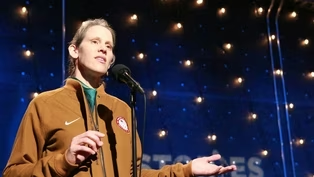
Preview: S9 Ep10 | 30s | What does it mean to find home? Is it lost family? A chosen community? Or living your own truth? (30s)
Providing Support for PBS.org
Learn Moreabout PBS online sponsorship











Support for PBS provided by:
Stories from the Stage is a collaboration of WORLD and GBH.